


At Cyber Security Tribe, we recently hosted an online fireside chat on Mythos and What CISOs Need to Do Next, bringing together a panel of three industry experts, including Alan Berry, CISO at Centene, Jason Barnes, Senior Director of Security Operations at Charter Communications and Frank DePaola, CISO at Enpro, to discuss what advanced AI capability means for cyber security leaders.
The discussion came at a time when concern about AI capability is moving quickly from specialist security circles into wider business and board-level conversations. With the public release of a Claude AI tool described as too powerful for public use, the question for CISOs is not whether AI changes the cyber risk for organizations, but whether their organizations are ready for what comes next.
The most useful way to think about Mythos is not as a single product, model, or event. It is a signal of direction. AI-assisted discovery, exploitation, triage, coding, automation, and decision support are becoming more capable and more available. Whether one specific tool is restricted, released, governed, or copied, the broader movement is clear, attackers will use AI to move faster, and defenders will need to use AI and stronger governance to keep pace.
That creates a practical challenge for CISOs. The response cannot be limited to a new policy document, a board update, or a cautious wait-and-see posture. CISOs need to revisit how they prioritize vulnerabilities, how quickly they can contain risk, how they govern internal AI use, and how they explain this shift to the business.
Drawing on the discussion, this article explores the practical guidance shared by our panel of experts, focusing on:
- How Mythos changes the CISO risk conversation,
- What security leaders need to do about speed and preparedness,
- How CISOs can build governance for the next AI shift.
Why Mythos Changes the CISO Risk Conversation
Mythos changes the CISO risk conversation because it makes speed, context, and business ownership harder to separate.
Traditional cyber security programs often assume a familiar rhythm. Vulnerabilities are disclosed, scanners detect exposure, tickets are raised, remediation is prioritized, maintenance windows are agreed, and teams work through a queue. That model already struggles in many organizations. AI increases the pressure because it can help identify weaknesses faster, connect issues together, and reduce the time between discovery and attempted exploitation.
This means CISOs can no longer rely only on standard severity ratings or broad categories such as critical, high, medium, and low. A vulnerability that looks moderate in isolation may become more serious when chained with other weaknesses in a specific environment. The real question becomes: what is exploitable in our context, with our architecture, our business processes, our dependencies, and our exposure?
That is a different conversation from simply asking what needs patching first. It requires a deeper understanding of the organization’s assets, internet-facing systems, third-party dependencies, business-critical workflows, and compensating controls.
It also changes how risk should be discussed with boards and executive teams. AI-driven cyber risk is not only a cyber security problem, it touches product, engineering, legal, privacy, operations, procurement, and business leadership. Any leader with budget authority to deploy AI, buy AI-enabled tools, accept exceptions, or approve new systems owns part of the resulting risk.
The CISO’s role is to make that risk visible, measurable, and actionable. Security leaders should be clear that they own the security program, but they do not own every business decision that creates AI risk. If every AI-related exposure is treated as “a cyber problem,” the organization will struggle to respond with the speed and coordination required.
A better approach is to make AI risk a shared business issue with defined ownership. The CISO should provide the guardrails, threat context, control expectations, and visibility. Business and technology leaders should own the decisions they make about systems, vendors, data, exceptions, and deployment timelines.
For boards, the priority should be confidence in the plan. They do not need every technical detail, but they do need to know that the organization understands the risk, has a strategy, is resourced appropriately, and is not treating AI as either a novelty or a distant concern.
What CISOs Need to Do About Speed and Preparedness
The clearest operational challenge for CISOs is velocity. AI changes how quickly attackers can work, but it also changes how quickly defenders must detect, decide, and act.
"The industry has spent years optimizing how quickly it can identify vulnerabilities. The challenge now is determining which ones can be used in an attack. As AI compresses the window between discovery and exploitation, security teams need to move beyond severity scores and focus on exploitability, reachability, and whether existing defenses would stop the attack. Speed matters, but speed without context simply creates a faster queue." Piyush Sharma, CEO & Co-Founder, Tuskira
Many cyber workflows are still built around human tempo: manual alert triage, tiered SOC escalation, annual risk assessments, scheduled vulnerability scans, ticket-based remediation, and fixed maintenance windows all assume risk can move through a managed queue. That assumption is becoming less reliable.
CISOs should start by rethinking vulnerability prioritization. The question should not only be “what does the scanner say?” but “what do we already know about our environment, and where would this weakness matter most?” Vulnerability management will depend less on waiting for scheduled scans and more on real-time asset intelligence, software inventory, exposure management, and knowing where vulnerable components exist before a new issue becomes urgent.
This is especially important where open source components, third-party software, and rapidly updated codebases are involved. Organizations need to know what is running, where it is running, who owns it, what business process it supports, and what options are available if a vulnerability requires immediate action.
Preparedness also requires a clearer view of mitigation. Remediation usually means fixing the issue or removing the exposure; until that happens, everything else is mitigation. Blocking ports, changing access controls, strengthening authentication, segmenting systems, restricting traffic, or increasing monitoring may reduce risk, but they do not make the underlying problem disappear.
AI-driven speed may force organizations to rely on interim controls more often. CISOs should know which mitigation options are available before an incident or high-risk vulnerability appears. Waiting until the moment of pressure to negotiate access, maintenance windows, or business disruption will slow the response.
This is where cyber resilience becomes more than a slogan. Organizations should move beyond standard tabletop exercises and test more severe scenarios. What happens if an AI-assisted threat rapidly identifies multiple weaknesses across business-critical systems? What happens if the organization cannot patch at normal speed? What happens if a key vendor tool, AI agent, or internal system creates unexpected exposure? What happens if the business must choose between disruption now and greater risk later?
These questions should be used to identify gaps in decision-making, escalation, ownership, communications, and technical response.
CISOs should also prepare the business for changes in operational cadence. Real-time or near-real-time patching may not be appropriate everywhere, but the organization should understand when faster action is necessary and what that means for production systems. This requires stronger relationships with engineering, development, manufacturing, operations, and business leaders.
Security teams cannot simply demand faster change without explaining business impact. Equally, business leaders cannot assume that old maintenance models will be enough in a faster threat environment. The organization needs a shared understanding of when to move, who can approve action, and how to balance continuity with protection.
How CISOs Can Build Governance for the Next AI Shift
The governance challenge is difficult because AI adoption is already moving faster than many control programs can support. Business teams are under pressure to find productivity gains, reduce cost, improve service, and experiment with new tools. At the same time, security leaders are trying to understand which AI tools are in use, what data they touch, which agents have access to systems, and how decisions are being made.
CISOs should not try to govern AI through broad statements alone. They need practical, enforceable rules that define which models are approved, which data classes can be used with each model, which environments are permitted, which coding tools are allowed, and which AI agents can take action in production.
An AI policy without operational detail will not be enough and governance needs to answer real questions: What tools are approved? What data can they process? Who can grant exceptions? How long do exceptions last? How are agents provisioned, monitored, reviewed, and retired? What happens if an unapproved tool is found? When can automated containment be used, and when is human approval required?
AI governance also needs inventory; organizations cannot protect what they cannot see, and security leaders should work toward visibility of AI tools, agents, services, extensions, data flows, and vendor capabilities. This may involve existing security platforms, data protection tools, procurement processes, endpoint controls, identity governance, cloud visibility, and newer AI security capabilities.
The goal should not be to block all AI use. That is unlikely to work and may push adoption into shadow channels. The goal should be to create safe lanes for the business. If teams know which tools, environments, and data uses are approved, they can move faster without creating avoidable risk.
This is also the right moment to rethink security team structure and skills. AI may reduce repetitive work, but it does not remove the need for human judgment. It raises the value of people who can validate AI output, understand business context, supervise agentic workflows, and make decisions when automation gets something wrong.
Security operations teams may need fewer people doing repetitive triage over time, but they will need more people who understand how to direct AI-assisted investigation, interpret outputs, challenge false conclusions, and own the decision-making that follows.
CISOs should treat this as a workforce design issue, not simply a cost-reduction opportunity. Replacing entry-level work with automation may create short-term efficiency, but it can also weaken the pipeline that develops mid-level and senior talent. Security leaders need to think carefully about how junior professionals will build judgment, intuition, and technical depth if the tasks that once trained them are moved to agents.
The best path is not to frame AI as a replacement for the security team. It is to use AI to remove avoidable friction, improve speed, and help people focus on higher-value decisions. That requires training, communication, and clear leadership.
You can watch the full online Fireside chat “Mythos and What CISOs Need to Do Next”, which is available on-demand.
You May Also Like
These Related Stories
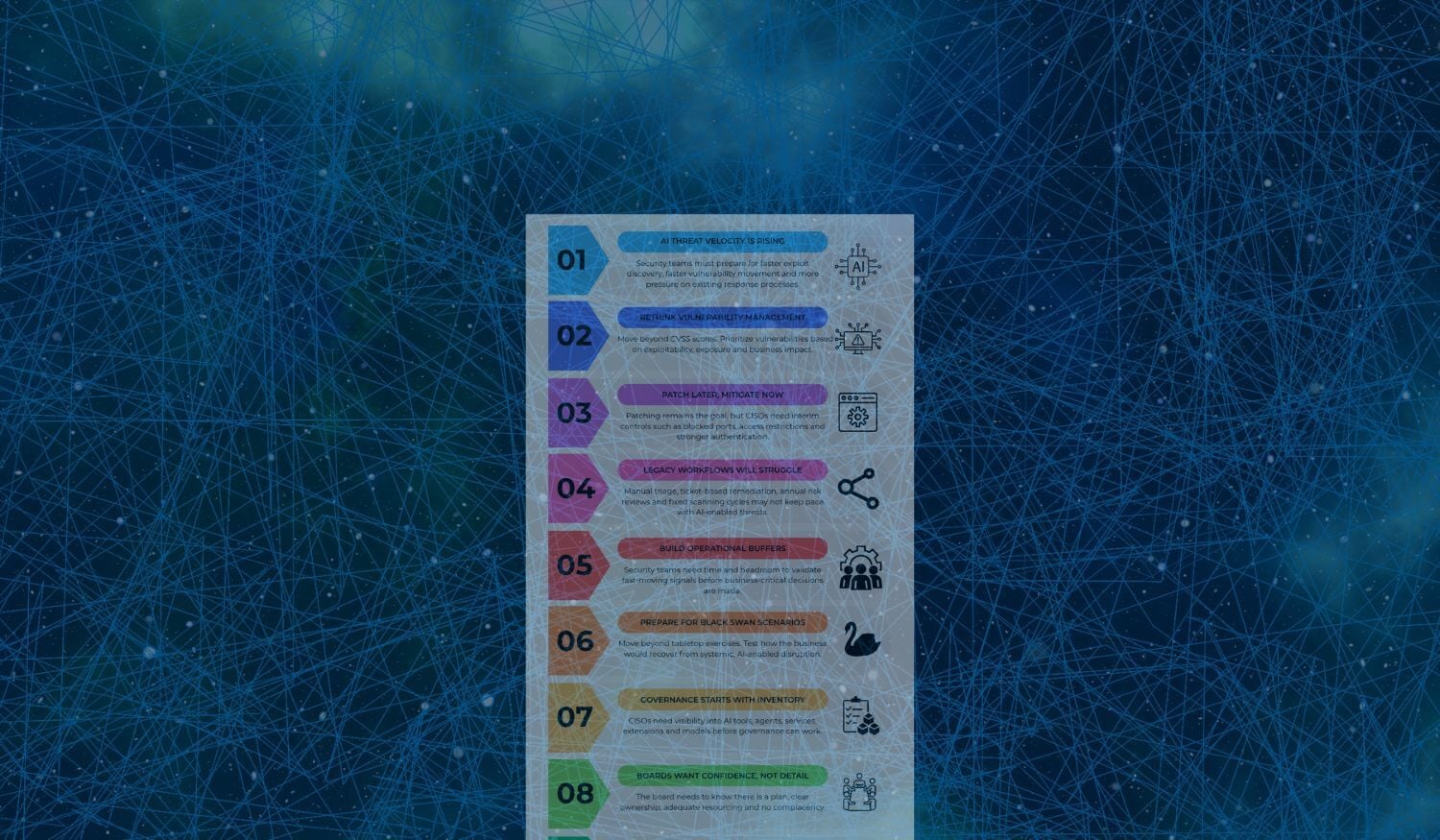
INFOGRAPHIC: Mythos and What CISOs Need to Do Next
The AI Myths CISOs Can No Longer Afford to Believe