



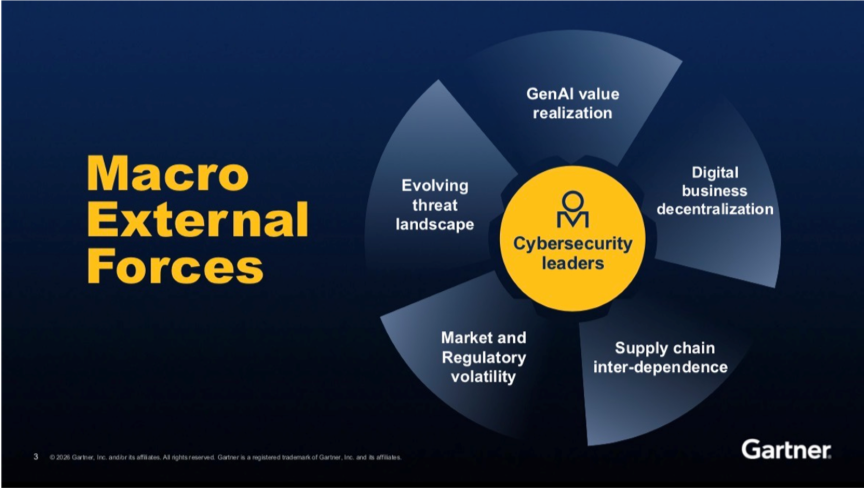
At Gartner’s Security and Risk Management Summit in National Harbor, Gartner Director Analyst Alex Michaels delivered a clear message to security leaders. The cybersecurity landscape is not simply evolving, it is being reshaped by artificial intelligence, emerging technologies, expanding governance obligations, and growing executive expectations.
For CISOs, the challenge is not just keeping pace with new threats. It is helping organizations navigate a period of continuous disruption while balancing resilience, innovation, and business growth. Michaels organized Gartner’s top cybersecurity trends for 2026 into three broad themes that reflect this reality. Organizations must normalize AI adoption, secure new technology frontiers, and transform governance models to support a rapidly changing business environment.
Taken together, these trends provide an overview of an important shift. Cybersecurity leadership is becoming less about managing controls and more about influencing business outcomes and the organizations that succeed will be those that adapt their security programs to support both innovation and resilience.
AI Is Forcing a Rethink of Human Risk
For more than a decade, security awareness training has served as a cornerstone of cyber defense. Yet despite annual training programs, phishing simulations, and awareness campaigns, human error remains a major contributor to security incidents. Traditional approaches are delivering diminishing returns against increasingly sophisticated threats.
Generative AI is accelerating the problem as threat actors can now create highly convincing phishing emails, deepfake videos, fraudulent voice messages, fake QR codes, and impersonation campaigns at unprecedented speed and scale. The barrier to entry for social engineering has fallen dramatically, giving attackers new opportunities to exploit trust across multiple communication channels.
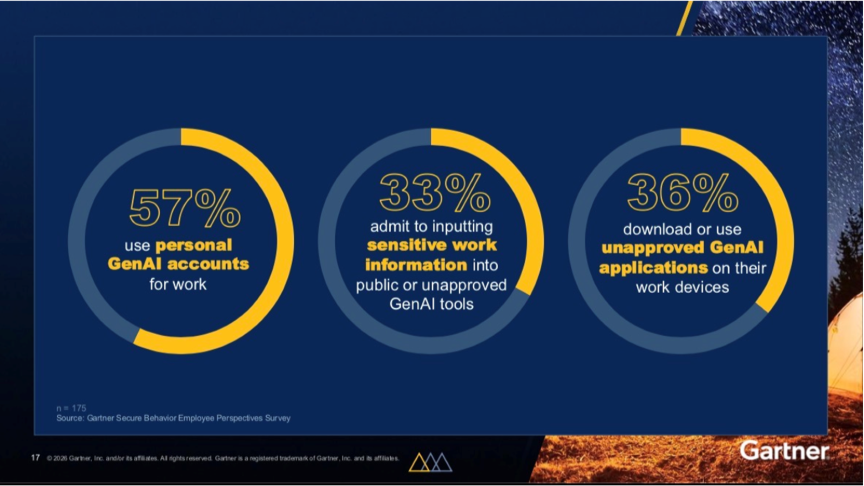
The challenge extends beyond external threats. Employees are adopting AI tools at a rapid pace, often without formal oversight and sensitive data is being entered into public AI systems, personal AI accounts are being used for work activities, and unsanctioned tools are finding their way into enterprise environments. These behaviors create risks that traditional awareness programs were never designed to address.
Security awareness must evolve into security behavior management. Rather than relying on annual training events, organizations should focus on contextual guidance, real-time interventions, and personalized coaching that influences behavior at the moment risk occurs.
AI Will Transform Security Operations Without Replacing Human Judgment
Security operations centers continue to face a familiar challenge. Alert volumes remain high, staffing shortages persist, and analyst burnout is an ongoing concern. AI-powered automation offers a compelling opportunity to improve efficiency and reduce operational strain. Many organizations are already exploring AI-driven solutions for alert triage, incident investigation, reporting, and response orchestration. These capabilities can help analysts focus on higher-value activities while reducing time spent on repetitive tasks.
However, Gartner highlighted a less discussed consequence of widespread automation. As more tasks become automated, security teams risk losing critical institutional knowledge and hands-on expertise. Junior analysts often develop their skills through the very activities organizations are most eager to automate. The result is a long-term talent challenge; if foundational investigative and analytical work disappears, future security professionals may struggle to develop the critical thinking and threat-hunting capabilities required when automation fails or encounters something new.
The most effective strategy is not replacement but augmentation. Human oversight remains essential, particularly for high-impact decisions and incident response activities. Organizations should also reinvest some of the productivity gains created by AI into training programs that preserve and strengthen critical security skills.
Post Quantum Security Demands Action Today
For many security leaders, quantum computing still feels like a future problem, but Gartner’s perspective is that waiting may be the greatest risk of all.
Although practical quantum computers capable of breaking modern encryption standards may still be several years away, the transition to quantum-safe cryptography will take far longer than many organizations expect. Large enterprises often require years to identify cryptographic dependencies, evaluate alternatives, and execute migration plans. This creates a dangerous window of exposure. Sensitive information stolen today could potentially be stored and decrypted in the future when quantum capabilities become available. The so-called harvest now decrypt later threat is one of the primary reasons organizations cannot afford to delay preparation.
Complicating matters further is the sheer scale of the challenge. Cryptography exists throughout modern IT environments, embedded within applications, infrastructure, devices, vendor solutions, and business processes and many organizations have limited visibility into where encryption is being used and how it is implemented.
CISOs should begin with discovery and inventory efforts. Understanding where cryptography exists across the enterprise is the foundation for any future migration strategy. From there, organizations can prioritize assets based on business impact, data sensitivity, and operational risk.
AI Agents Need Their Own Identity Controls
The rise of agentic AI is introducing a new category of security challenge. AI agents are increasingly capable of performing tasks, accessing information, making decisions, and interacting with enterprise systems with varying degrees of autonomy.
Most identity and access management programs were built around human users. Agentic AI changes that equation. Organizations must now manage a rapidly growing population of non-human identities that may operate continuously and at machine speed. Without proper controls, AI agents can become overprivileged, difficult to monitor, and challenging to govern. As their capabilities expand, so does the potential impact of misuse, error, or compromise. An autonomous agent with excessive access can create risks that are both significant and difficult to detect.
Clear accountability for every AI agent deployed within the organization needs to be established. Each agent should have a unique identity, a defined owner, and access permissions aligned with the principle of least privilege. The same rigor applied to human users must now extend to machine identities.
Governance Must Evolve for Agentic AI
Identity management is only one piece of the challenge, the broader issue is governance.
Low-code and no-code platforms are making it easier than ever for employees to create AI-powered agents. While this democratization of innovation can accelerate business value, it also introduces significant oversight concerns. Many organizations may soon discover they have dozens or even hundreds of AI agents operating outside formal governance structures.
Not all agents pose the same level of risk. Some may perform simple tasks with limited access to sensitive information. Others may operate with significant autonomy while interacting with critical business systems and confidential data. A risk-based governance model is essential and organizations should classify agents based on factors such as autonomy, data sensitivity, business criticality, and system access. These classifications can then guide security controls, monitoring requirements, and approval processes.
Continuous discovery is equally important; security teams must be able to identify approved agents as well as shadow AI deployments that emerge outside established channels. Effective governance begins with visibility and continues through ongoing assessment and monitoring.
The Modern CISO Must Lead Through Influence
Perhaps the most significant trend Gartner identified is the continued expansion of the CISO role itself.
Security leaders are increasingly responsible for areas that extend beyond traditional cybersecurity. Business continuity, privacy, disaster recovery, resilience planning, regulatory readiness, and enterprise risk management are all finding their way into the CISO portfolio. This evolution reflects growing confidence in security leaders as strategic business advisors with boards and executive teams increasingly view CISOs as experts in uncertainty, resilience, and organizational risk. While this creates new opportunities for influence, it also creates the risk of overload.
Attempting to personally own every responsibility is not sustainable. The most successful CISOs in 2026 will recognize the difference between ownership and influence. Rather than serving as the sole owner of every risk, they will establish governance frameworks, define standards, and enable accountability across the business.
By empowering business leaders to participate in risk management while maintaining appropriate governance and oversight, CISOs can extend their impact without creating organizational bottlenecks.
The Road Ahead
The six trends Gartner identified for 2026 point to a common conclusion. Cybersecurity is becoming more interconnected with business strategy, technology innovation, and enterprise governance than ever before.
AI is transforming how employees work, how attackers operate, and how security teams defend the organization. Quantum computing is forcing long-term planning today. Agentic AI is creating entirely new governance and identity challenges. At the same time, the role of the CISO continues to expand beyond traditional security boundaries.
Success in 2026 will depend on balancing innovation with resilience. The goal is not to slow transformation but to guide it safely. Organizations that embrace this mindset will be better positioned to navigate uncertainty, support business objectives, and build sustainable cyber resilience for the years ahead.
Slides attributed to Gartner.

The AI Frontier: Balancing Innovation and Risk in the Enterprise

The Evolution, Challenges, and Future of Third-Party Risk Management